|  | ||||||||||||
| | | |||||||||||
| Why snowshoeing may be cardio king. In case you failed to notice (which would be your loss), March 5, 2005, was a huge and historic day for snowshoe racing. People forgot to bring the trumpets and banners, but the notoriously body-grinding art of high-country romping secured an undeniable place in wintersport culture. It may have even edged closer to Olympic entry. On the day in question people were kicking up powder from sea to shining sea. In Beaver Creek, Colorado, the Jeremy Wright North American Snowshoe Championships brought together five hundred competitors from around the world. In Anchorage, Alaska, an elite gathering of shoers kicked off the United States National Snowshoe Championships. And in the frosted high country of New England, the Western Massachusetts Athletic Club unleashed frenzied hordes through pines and maples.
Meet some prime contenders. Twenty-six-year-old Josiah Middaugh of Vail, Colorado, is one reason the sport is demanding its rightful place. At Beaver Creek, he took first in all four events (and won the championship). His snowshoeing prowess, along with his triathlete background, has served him well in multidisciplinary events. Middaugh also won the 2005 Mount Taylor Winter Quadrathlon, a notably grueling amalgam of biking, running, cross-country skiing, and snowshoeing. “Snowshoeing has a very fast learning curve. If you can walk or run, you can snowshoe race,” says Middaugh. “People from a wide variety of sports can do well, but cyclists, triathletes, and runners have an advantage. It’s more about aerobic capacity than leg speed.” Like most winning shoers, Middaugh brings his strength and agility, but he also brings his brainpower. His prerace ritual includes a careful study of the field. He looks for vulnerabilities in the area of preparedness and, of course, tolerance for what some might think of as pain and exhaustion. “My strategy is to race the course as fast as I can. I don’t wait too long to make a move. I like to drive everybody into oxygen debt early on.” Danelle Ballengee, 33, of Dillon, Colorado is another ambassador of the sport, not least because she’s one of the world’s top female snowshoe racers. Like many converts, Ballengee is an athlete who took to shoeing because of its one-of-a-kind blend of extreme cardio and full-body finesse. “Lately, the snowshoe racing season has been my focus,” Ballengee says. “Instead of snowshoeing to get in shape for running, I’ve been running to get in shape for snowshoeing.” Ballengee is known for her wily ways and fierce competitiveness—and for her ungodly fitness. To claim the Fourteeners Female Speed Record, she climbed all fifty-four of Colorado's 14,000-foot peaks in fifteen days (her aerobic capacity is slightly above average). Running has its attractions, but these days Ballengee puts her shoes on and channels her gift for sustaining an Olympian heart rate toward what she considers the ultimate test. In the East, Paul Low, 31, of Amherst, Massachusetts, has become the guy who’s always out front. Low is the top-rated 2005 Western Massachusetts Athletic Club snowshoer, and the experience has served him well in national events. He’s an aerobic monster, but his reasons for competing go beyond the joys of endurance. “I’m inspired to snowshoe race by the natural beauty of the race courses and by all of the cool people that I’ve met while competing,” says Low. Maybe such laid-back elocutions are a psyche-out, but apparently it works. Julie Udchachon, 34, of Eagle River, Alaska, is another competitor of note. Udchachon (oo-cha-chon) is big on testing limits. “I snowshoed about seventy three miles of the Susitna 100 in Alaska after running the first twenty-five,” Udchachon says. “Somewhere around the ninety-mile mark my body temperature dropped and I began to suffer from hypothermia. I ended up passing out at mile ninety-eight. It was a great learning experience. I plan on doing it again next year.” Nikki Kimball, 34, of Bozeman, Montana (by way of Elizabethtown, New York), is also fueling the sport’s growing popularity, in part by winning the 10K National Snowshoe Championships. For Kimball, who is also a champion trail runner, snowshoeing is a means to an end. “I love snowshoe running,” says Kimball, “but it’s an adjunct to my running career. I’m a triathlete. I don’t train for snowshoe racing. I use it for strengthening. It’s a very affordable way to train.” Story by Ryan Alford More: Feeding the Fire >>>...||...More: Snowshoe Racing at the Top >>> .
| ||||||||||||
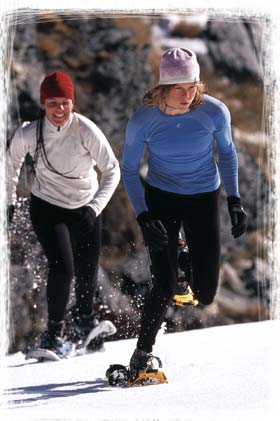 The racers were separated by times zones and snow depth (and by levels of fitness and degrees of determination), but they were united in their dedication to putting the sport on the map. There was more collective stomping through powder (or in the case of New England, though ice, snow, and unforeseen combinations thereof) at any time before or since. It had been six millennia since humans figured out how to cavort across the snowpack. After a lengthy crawl, snowshoeing has hit high speed.