|  | |||||||||||||||||||||
| | | ||||||||||||||||||||
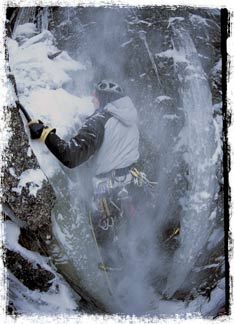
| Why N.E. ico-o-philes like it cold and hard For New Hampshire climbers, “Live Free or Die” is more than a tag line. Same with “Forever Wild,” the stark maxim of the Adirondacks. The words apply to some more than others. Ice climbing gurus Jim Shimberg, Joe Szot and the up-and-coming Erik Eisele are cases in point. If it’s cold, miserable and, uh, cold, these die-hard Yankees get a warm inner glow. It’s no coincidence that they all reside in the relentlessly bumpy stretch between the Daks and New Hampshire’s White Mountains. During the unending winter, the landscape gives “still water” new meaning. There are frozen cascades (and lesser drippages) aplenty. The ice routes of the Northeast, scrappy and bullet-hard, feed into the gene pool. If you prefer picks to crimps and measure ice in vertical feet, this is where, and who, you are.
Shimberg, aka, “Shim,” aka, “Ice Daddy,” once rode the entire collapsing ice column of Cathedral Ledge’s classic route, Repentance (NEI 5). “It’s almost hard to believe that ice can hold you,” he says. Shimberg is one of New England’s most prolific and experienced ice climbers, and he may in fact have ice water in his veins. So far, he’s the only one to solo Omega (NEI 5+) on Cannon Cliff, one of the country’s longest and sketchiest ice routes. Szot has also flirted with mortality in the frozen world. He once survived a 70-foot fall on the Daks’ Power Play (WI 5+), a miraculous whipper that snapped his antiquated ice screw in half and bent his partner’s ice-tool pick—part of their belay anchor—ninety degrees the wrong way. “Unbelievably, the only thing I hurt was my belayer,” Szot recalls. “Two guys who were climbing next to us looked at me and said, ‘Uhhh … you’re not hurt?’” Ice gear has made huge leaps since then. On the sensation of placing a modern ice screw, Szot is quietly ecstatic. “Nothing feels better.” With safer gear, people are doing stuff undreamt of (or at least unadvisable) in fairly recent history. These days, a quarter-size patch of frozen water can support your weight. And instead of taking a half-hour to place, ice screws can be threaded in a minute. A certain degree of grace has come into play. Ice climbing used to be slow and labored. By comparison, it’s become balletic.
“A good ice screw is like … heaven,” says Eisele, a Portland, Maine, student who finds time to solo up and down Mount Washington’s storied ravines. But that doesn’t mean you leave your fearless audacity at home. “It’s one of those things you have to have confidence in, but still, I’m like, mamma!” Eisele has climbed Grade VIs in Yosemite and a lot more, and he has a long-established taste for rock. But in November he flips the switch. “Everything starts out thin, and you have to start scratching up rock to reach the ice. That’s when I know I’m amped.” Eisele’s reverence for those-who-have-gone-before is not unusual among climbers born in the 1980s. They know what it must have been like with bottom tier gear. “I was climbing Cathedral’s Standard Route, thinking about climbers in the 1970s on this grovely, insecure pitch … and I was using Black Diamond Vipers!” State-of-the-art equipage has not altered the essential experience, however. Biting wind, deteriorating weather, the feeling of chimneying against a dripping column with menacing ice daggers finding their way into your waterproof shell, topping out in a blizzard, the screaming barfies—this kind of fun is timeless. Judging by the growing number of icers, the barfies (that exquisite discomfort of thawing fingers) is fair trade for the rewards of climbing the New England winter. “I love that you can just get away from the crowds,” Szot says. “Ski in five miles to Avalanche Lake, and you’ve just entered the Yosemite of the Daks!” Eisele agrees. “It’s cold and miserable. We go out there to hate life, and end up loving it.” Story by Andrew Bisharat .
| |||||||||||||||||||||