|  | ||||||||||||
| | | |||||||||||
| High five-figure peaks, very far from home. The amazement of arrival Step out of a cab in Quito and you’ll have to acclimatize to another planet. Unreadable signs (if you don’t speak Spanish), narrow winding streets, open drainages, barnyard animals on leashes, tiny Japanese cars zipping by, high-pitched horns, bicycles, earth-colored buildings, hole-in-the-wall restaurants (literally). And that’s not counting the people, who are everywhere, loudly, all the time. “Why did I study French?” Alexis Alloway asked herself as she attempted to buy a soda. One look up and you know the reason you came. Very big peaks, colossal-looking, forbidding, otherworldly, dominating the horizon in all directions. In the capital city of Ecuador last December, EMS Climbing Guides Tim Martel and Sara Reeder were on a recon mission for a possible guided expedition. Alexis, a Store Guide, was there for the experience (and perhaps the affordable vices). This threesome had a history: they’d spent the previous fall touring the U.S. East Coast and working the EMS Raise the Roof tour. The true challenge—one would think—lay well beyond the city, on the snow covered volcanoes of Illiniza and Cotopaxi, and along the trek to Ingapirca. But this crooked metropolis was no cakewalk. Finding a bathroom and a place to eat was a major undertaking. Acclimatization of the mountainous kind
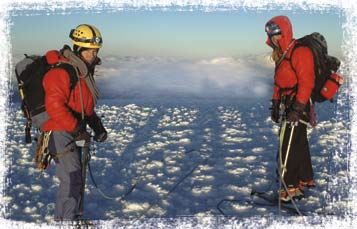
“OK, this is cool, let’s go down now. I feel like someone is stabbing me in the back of the head.” This was Alexis’s state of mind on the summit of Illiniza Norte (5126 meters). It was the highest she’d been in her life. Every organ cried out for oxygen, and Illiniza Norte was only the acclimatization peak. Tim’s response—perhaps due to some Raise the Roof synchronicity—was eerily similar. “It’s the curse of the mountain. You suffer, and there is something addictive about that.” After their bodies managed to suck enough sustenance out of very thin air, the future brightened. Higher summits were conceivable. Presidentials reminder Screaming winds. Shriveling temperatures. Snowfields so exposed that you would laugh out loud if it weren’t so wrong. Visibility pretty much zero, and a penetrating wet coldness that delivers a chill despite your layering system and level of exertion. “It was so similar to Mount Washington it’s crazy,” Tim said. Except for the small matter of altitude. This was Cotopaxi (5897 meters), the second highest peak in Ecuador. Sara led the way across the glacier and onto the mountain slope that night. Partway up the first snowfield, she came around a corner to strong winds and low visibility. “It just kept feeling colder and colder. Visibility sucked, there was thick freezing fog, and the wind seemed to be increasing. If I hadn’t had so much time in the Whites in the winter, I might have turned back. Instead, I just kept trudging uphill in hopes to find some sort of windbreak—a cornice, a rock, anything.” “At one point I looked down at the crevasse rescue gear hanging on my harness,” Tim said. “It was so encased in ice it was useless. Falling in would probably have meant death.” Tim had been above 5000 meters at least fifteen times. This was the worst weather he’d seen. Out of thirty-five-or-so parties that started up Cotopaxi that day, the EMS crew was one of two that summited.
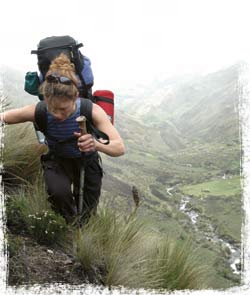
The EMS threesome spent their final Ecuadorian days trekking in the oxygen-rich lowlands. The Inca Trail was laid out about a half-millennium ago, fifty years before Columbus found and forever altered the New World. At the time, the Incan Empire extended from today’s Chile to what is still Ecuador. Sara, Tim, and Alexis covered a thirty-five kilometer stretch between Achupallas and Ingapirca. “The trek was the best part of the trip. It’s funny, because I’m a climber and an adrenaline junkie,” Tim said. “But the anthropology lesson was the most memorable.” They passed through remote highlands with landscapes of almost absurd austerity and beauty. The indigenous communities did not appear to have modernized since the 1500s or so. “You could put yourself in the footsteps of the people who built it and walked it,” Sara said. “The big peaks were the goal, but the people and the culture captivated us just as much.” The final word from the EMS crew? An Ecuador mountaineering adventure is perfect for those seeking a new kind of balance. By Janet Bergman .
| ||||||||||||
 Ancient roads