|  | ||||||||||||
| | | |||||||||||
| You already know this, but it will be a long time before the story gets old. When Mountain Hardwear-sponsored athlete Ed Viesturs summited Annapurna on May 12, 2005 (with partner Veikka Gustafsson), he became the first American to summit all fourteen of the world’s peaks above 8000 meters and only the sixth person in the world to do so without supplemental oxygen. For most people, the achievement confirmed Viesturs’ status as America’s greatest mountaineer. One simple fact says a lot: Viesturs has stood atop the world’s highest mountain six separate times. He is now officially retired and lives in the Seattle area. On Annapurna and other peaks, Viesturs used a prototype of the Mountain Hardwear Annapurna tent (the EV2). The idea to climb all fourteen without bottled air became “Endeavor 8000” in 1994, when Viesturs had already summited Kanchenjunga, Everest, and K2. After that monumental push, the rest of the above-the-clouds world seemed within reach. In 1995, he got to the top of Makalu, Gasherbrum I and Gasherbrum II. Many epic climbs would follow, along with many setbacks. Viesturs never lost sight of the self-preservational discipline required of going up and getting down. In 1996—that year of death for top-of-the-world alpinism—Viesturs saw friends and colleagues Rob Hall and Scott Fischer, along with others, join the list of Everest’s victims.
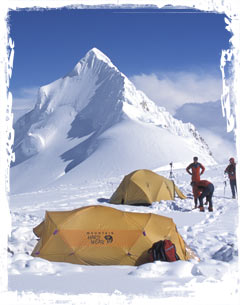
By April 2005, after Everest, K2, and the rest, Annapurna (26,545 feet) had become a nemesis for Ed Viesturs. The mountain had his number. One of his two previous attempts had ended just short of the summit, when Viesturs implemented his non-negotiable policy—err on the side of caution, always, and do what’s necessary to get out alive. “Getting to the top is optional, but getting down is mandatory.” This final successful effort was the culmination of an eleven year project and a lifetime of mountaineering—and it almost didn’t happen. The obstacle this time was gale-force winds. Viesturs and partner Veikka Gustafsson hunkered down in their tent at Camp III, where the rhythms of high-altitude camp life were irregular at best. Over three days and nights, Viesturs and Gustafsson slept for about three hours and subsisted on a handful of energy gels. At 1:30 AM, day three, the weather became acceptable. The final leg was a massive effort of will and endurance on almost no sleep and food. Viesturs’ non-negotiable turn-around time was 2:00 PM. Eleven hours (and years) later, on or about 2:00 PM, the top of the mountain was underfoot. Viesturs was badly dehydrated, but relieved. And also thankful. An Italian team’s help in locating the fixed ropes that Viesturs and Gustafsson used on descent proved crucial. It was a fitting end to the eleven year quest, and to Viesturs’s career. That historical May day was Viesturs’ toughest ever on a mountain. Ed's tent. After many cumulative days, weeks, and months of honing the art of survival (and sometimes, weather permitting, comfort) in the world’s harshest conditions, Ed opted for the Mountain Hardwear® EV2 on Annapurna. He had some very well-considered reasons: lightweight; self-venting; virtually stormproof; single wall construction with integrated vestibule; indestructible UVX windows; narrow enough to pitch on a ledge. .
| ||||||||||||
 Endeavor 8000—the final chapter.